Vitalia Acosta

Growth Mindset Plan
GROWTH YOUR MINDSET
The growth mindset has significantly changed my life to improve my learning. You have established a positive outlook that is possible with hard work and dedication.
In this course, this mentality is growing. I have learned a lot and acquired a lot of knowledge in many things, such as creating my electronic portfolio and Zoom meetings. I have read to write a lot again and know how to write.
In this learning feedback process, which I entered with a lot of confusion, now I look back and say that I achieved the first stage of this great vision, a great goal, ideas, projects, tools, and much learning and knowledge.
The plan is to document my experience implementing a growth mindset plan in my school district.
As a teacher, I have realized the importance of using a growth mindset to foster a love of learning in students. Teachers can positively impact the lives of our students and help them achieve their goals and objectives. They become learners using technological resources to strengthen their knowledge and skills. Bringing a growth mindset to the school helps students, staff, and administration develop to meet objectives and goals throughout their lives.
I have a lot to give my students for this new school year, looking at the process behind the implementation and my continued effort to embed a growth mindset in my classroom through daily, weekly, and monthly routines. As I move forward, I plan to adopt a growth mindset in all areas of my life.
I'm still learning; I give my best one day at a time. The tools I have acquired in this course have made me change my mind on a learning and personal level; I want to continue learning to meet my goals and objectives.
IMPORTANCE OF THE GROWTH MINDSET
The growth mindset is an essential factor for success in the life of human beings. The growth mindset refers to the understanding that people see their talents and abilities growing as a determined effort is made.
This contradicts a fixed mindset, which is the belief that our abilities are already set and cannot change (Dweck, 2006, Chapter 1). Mindset scholars have discovered that people have a mix of mindsets; for some things, we are fixed, and for others, we believe in mental growth (Dweck, 2015, p. 3).


FIXED MINDSET
The fixed mindset is when we think that we may not be able to do something or we do something that doesn't work out the way we want in any area of our lives. We avoid challenges, we often give up easily, we see that our efforts are fruitless, and many times, we feel threatened by the success of others.
GROWTH MINDSET
The growth mindset helps to see that much more can be done. When they look for a way to get ahead with effort and develop new skills to achieve future goals, they fight to achieve the objectives.

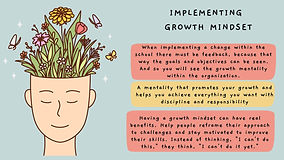

The power of still is implicit and lets you know you can improve; isn't that a great way to live life? If you keep working on what you want to achieve to improve the results, it increases the chances that one day you will achieve it. You still need to do it.
Upon completing my studies in June 2010, I began my plan to share and support the growth mindset with my students and parents as I pondered the best approach to introduce this mindset to my students.

(4036) Coaching with a Growth Mindset | Simon Sinek - YouTube
(3921) Developing a Growth Mindset with Carol Dweck - YouTube
I tell my parents and students that I seek growth, which is my classroom atmosphere. I tell my students they will do well and let them know their importance. I make no distinction with them; I speak to them as if success belonged to everyone. I focus on growth and have my students do the same.
I tell them every day that if someone is missing to complete a task, they just haven't mastered this skill "yet." It has been so influential in my classroom. When I watched the video "Developing a Growth Mindset" (2014), I was blown away when Dweck showed the illustration of how the brain was "on fire" with "YET!" The brain loves "yet" too! The word "still" creates a feeling of confidence in a person. It lets you know that even if you have “yet” to be successful with this skill or challenge, you can still do it. You still learn, grow, and progress. You just haven't done it "yet."
When it comes to digital innovation, the power of still is that we need to confront others with why it should be done and give them a higher purpose.
In many cases, this is the real world, and the work you do today will determine your outcome in the future. In my original plan, I talked about how my campus was trying to focus on positivity so students would stay motivated in their small groups or station rotations. I still have work to do to fully implement my plan, such as reminding my students how to use the work and helping them reflect on their progress in small groups. When I was walking to my class, I saw students asking thoughtful questions, so we were on the right track.
At Thompson Elementary, many changes are needed to help students reach their full potential. The principal always says the “power of yet” when presenting any plans, so I feel confident that I can work through the professional development course I have designed to align with my Plan to Offer Time, which is to intentionally create a meaningful learning environment using two-way dual language with blended learning station rotation.
The growth mindset is a personal journey; I am just beginning. starting this master's degree has been my main objective and is a fundamental factor in my life. However, it was part of my fixed mentality; I had many excuses to start, fear and lack of time. I am now determined to apply the growth mindset by overcoming challenges using my talents and abilities to grow as I work with determination to focus less on the idea of "how can it work" and more on the concept of "how can I make this work." it works." Brock and Hundley (2016) mentioned one of the monthly mantras: "Feedback is a gift—accept it."
I look forward to receiving feedback from my teachers and peers and using it to help me grow as an educator and learner. To achieve my goals and goals.
References
Brock, A. & Hundley, H. (2016) Dweck, C.S. (2010) Change your mindset: How can you change from a fixed mindset Dweck, C. S. (2016) Recognizing and overcoming false growth mindset. Retrieved from
Recognizing and Overcoming False Growth Mindset | Edutopia
https://www.understood.org/en/articles/growth-mindset
Dweck, C.S. (2006) Mindset: The new psychology of success. New York, NY: Ballantine Books
Dweck, C.S. (2010) Change your mindset: How can you change from a fixed mindset to a growth mindset? Retrieved from
http://mindsetonline.com/changeyourmindset/firststeps/index.html
(4036) Coaching with a Growth Mindset | Simon Sinek - YouTube
(3921) Developing a Growth Mindset with Carol Dweck - YouTube